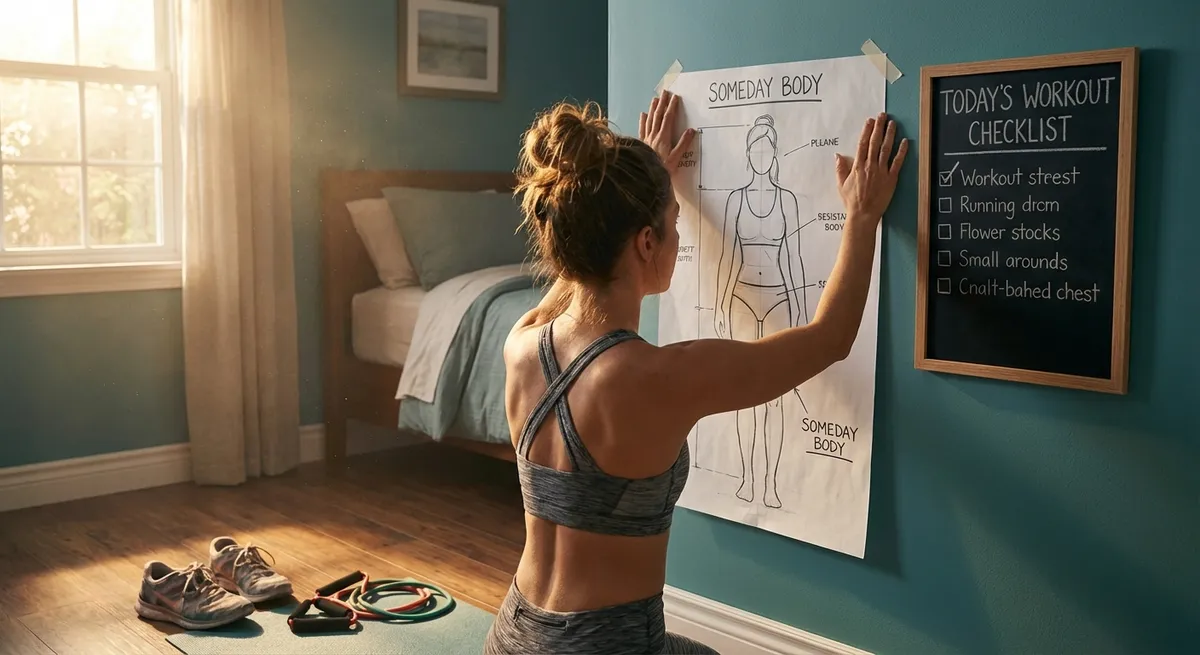
Today, you’re building a blueprint: clear goals plus smart tracking so every workout, every walk, every rep has a purpose. Let’s turn your effort into evidence.
Build Goals That Actually Pull You Forward
Most people stall out because their goals are blurry: “get fit,” “lose weight,” “tone up.” Vague goals don’t trigger action; specific ones do. Your first move is to build goals that are so clear you could hand them to a stranger and they’d know exactly what you’re chasing.
Instead of “get stronger,” try: “Deadlift 225 lbs for 5 reps by September 30.” Instead of “exercise more,” go with: “Move at least 30 minutes a day, 5 days per week, for the next 8 weeks.” The more specific the target, the easier it is to track progress and spot wins.
Make your goals:
- Specific: What exactly are you improving? Strength, endurance, body fat, energy, mood?
- Measurable: Put numbers on it—sets, reps, weight, time, distance, frequency.
- Time-bound: Give every goal a deadline so your effort has urgency.
- Flexible: You’re not a robot. Goals can be adjusted, not abandoned. If life hits hard, scale, don’t quit.
Once your goal is clear, you’re ready for the secret weapon: tracking. Not to obsess over perfection—but to see proof that you’re moving.
Why Tracking Turns Effort Into Results
You can’t improve what you don’t measure. When you track your training, your brain gets constant feedback: “I’m not stuck. I’m actually moving.” That turns motivation from a random feeling into a renewable resource.
Tracking helps you:
- Spot real progress even when the mirror feels slow to change.
- Avoid plateaus by showing when you’ve been lifting the same weights or doing the same distances for weeks.
- Stay honest about skipped workouts, late nights, or random snack attacks.
- Celebrate tiny wins that would otherwise go unnoticed.
Think of tracking as your personal highlight reel and game tape in one. You see where you crushed it and where to tighten things up—without judgment, just data.
Now let’s break down 5 powerful tracking tips to keep you locked in and accountable.
Tip 1: Track Behaviors, Not Just Outcomes
Most people only track the scale or progress pics. That’s outcome tracking—and it moves slow. When results feel slow, motivation tanks. The fix? Track the things you can control every single day: your behaviors.
Track actions like:
- Workouts completed this week
- Total steps per day
- Hours of sleep
- Protein intake
- Water intake
- Mobility or stretching sessions
These are levers you can pull today. When you hit a streak—5 workouts in a row, 7 days of 8k steps—you feel momentum, even if the scale hasn’t shifted yet. Behavior tracking turns every day into a winnable game.
Action today: Choose 2–3 daily behaviors and start logging them: “Did it / didn’t do it.” Keep it simple and consistent.
Tip 2: Use Progress Markers That Fit Your Goal
Your tracking needs to match your mission. If your goal is endurance, but you only track scale weight, you’re missing the story. Align your progress markers with your actual target so your feedback is relevant and motivating.
Examples:
- Strength goals: Track sets, reps, and weight for key lifts (squat, deadlift, bench, rows, presses).
- Fat loss goals: Track weekly average weight, waist measurements, and progress photos every 2–4 weeks.
- Endurance goals: Track distance, time, and pace for runs, rides, or swims.
- Performance/energy goals: Rate daily energy, mood, and stress on a 1–10 scale.
When your data fits your goal, you stop asking, “Is this working?” and start seeing exactly where it is working—and where to adjust.
Action today: Write down your main goal and list 2–3 numbers that best represent progress toward it. Those are your primary metrics.
Tip 3: Turn Tracking Into a Daily Ritual, Not a Chore
If tracking feels like homework, you’ll quit. The solution is to wrap it into something you already do every day—no extra willpower required.
Try these habit pairings:
- Morning: Log your weight, sleep hours, and resting mood right after brushing your teeth.
- Post-workout: Record sets, reps, and how you felt before you even leave the gym.
- Evening: Check off your daily behaviors (steps, water, workout) right before you scroll your phone or watch a show.
Keep it fast and frictionless. Use your phone’s notes app, a tracking app, or a simple notebook dedicated to training. One minute of tracking can save you weeks of guessing.
Action today: Decide when you’ll track (morning, post-workout, night) and stick to that same time for the next 7 days.
Tip 4: Review Your Week Like a Coach, Not a Critic
Raw data is good. Reflected data is powerful. Once a week, step back and look at your numbers like a coach reviewing game film—calm, curious, and focused on improvement, not judgment.
Ask yourself:
- How many workouts did I plan vs. how many did I complete?
- Did my weights, distances, or times improve anywhere?
- What patterns do I see—bad sleep before missed workouts, weekend eating off-track, etc.?
- What’s one small adjustment I can make this week?
Instead of saying, “I failed,” you say, “Interesting—Thursday workouts keep getting skipped. Let me move them to Saturday.” That mindset shift keeps you in the game when old you would have quit.
Action today: Pick a weekly “check-in day” (Sunday works great). Spend 5–10 minutes reviewing your week and writing one win and one adjustment for the next week.
Tip 5: Make Your Progress Public (Strategically)
Accountability hits different when someone else knows your plan. You don’t need to broadcast every rep to the entire internet—but sharing your goals and tracking streak with a small circle can dramatically boost follow-through.
Ways to use social accountability:
- Tell a friend or partner your exact weekly targets: “3 workouts, 8k steps daily, bed by 11 pm.”
- Share a screenshot of your step count, workout summary, or weekly streak on social media.
- Join a fitness community where people post check-ins, not just highlight reels.
- Do “proof posts” once a week: not just your goals, but your actual completed actions.
Public progress flips the script from “I’ll try” to “I said I would—time to show receipts.” It’s not about perfection. It’s about keeping promises in the open.
Action today: Pick one person (or one online community) and share your main goal plus your tracking method. Commit to one update per week.
Conclusion
Your fittest self isn’t built in a single workout. It’s built in the tracking—in the tiny, daily proof that you showed up, moved your body, and honored your goal.
- Clear goals give your effort a target.
- Tracking behaviors keeps you locked into what you can control.
- Reviewing your data keeps you improving, not guessing.
- Strategic accountability keeps you honest when motivation dips.
You don’t need perfect days. You need documented days. Start tracking today—one workout, one metric, one honest check-in—and let your progress become undeniable.
Sources
- Centers for Disease Control and Prevention – Physical Activity Basics - Outlines recommended activity levels and benefits of consistent exercise
- American College of Sports Medicine – ACSM Guidelines for Exercise Testing and Prescription - Evidence-based standards for setting and monitoring fitness programs
- Harvard T.H. Chan School of Public Health – Physical Activity and Health - Explains how regular activity and tracking habits relate to weight and health outcomes
- National Institutes of Health – Behavior Change and Goal Setting - Reviews how specific, measurable goals support lasting behavior change
- Mayo Clinic – Exercise: 7 Benefits of Regular Physical Activity - Summarizes the physical and mental benefits that build motivation to stay consistent