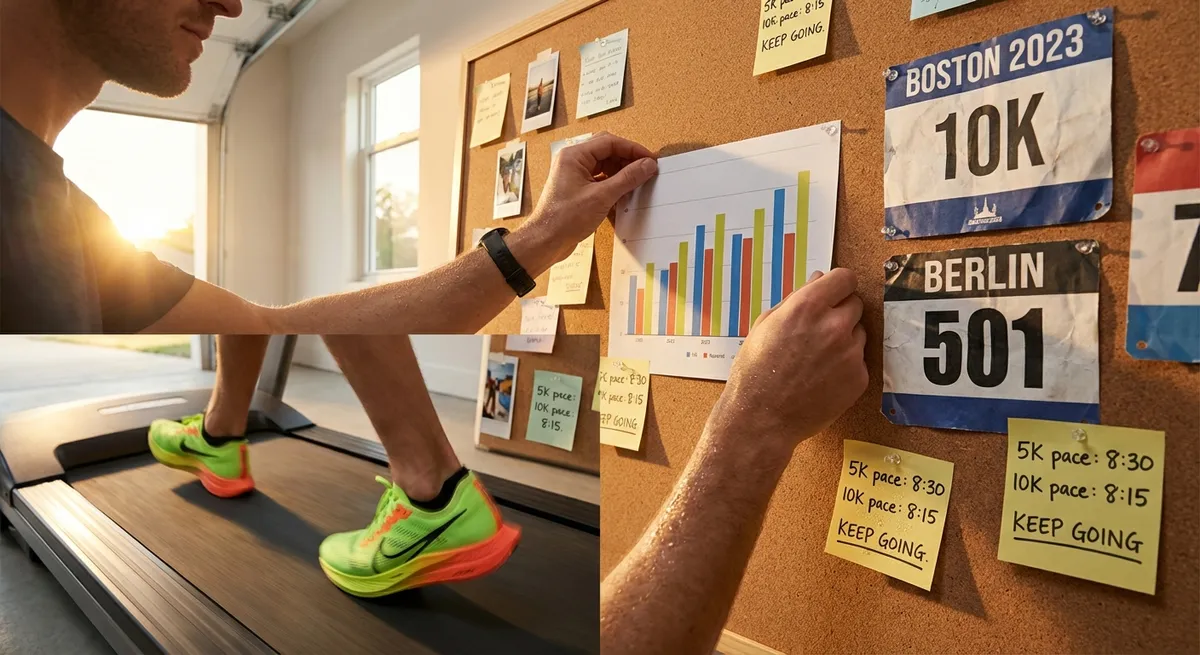
Let’s turn your tracking into a momentum machine that keeps you locked into your goals and proud of your progress.
Tip 1: Track Fewer Things, More Consistently
Most people fall off tracking because they try to track everything—sets, reps, calories, macros, steps, sleep, water, mood, vitamins, and the phases of the moon. Two weeks later, they’re burned out and done.
Instead, choose 3–5 key metrics that actually move the needle for your current goal and track those ruthlessly. Examples:
- Building strength? Track: weight lifted, sets/reps, weekly PRs, workout frequency.
- Fat loss? Track: weekly average weight, waist measurement, daily steps, workout frequency.
- Endurance? Track: distance, pace, heart rate, weekly total time.
Make it simple enough that you can do it on your most chaotic, tired, “I barely have energy” kind of day. Consistency beats complexity every time.
Action move: Today, write down your top 3–5 metrics. Commit to tracking only those for the next 30 days—no extras, no overthinking.
Tip 2: Use “Before and After” Tracking, Not “Perfect or Fail” Tracking
Too many people treat tracking like a pass/fail test: “I hit my numbers or the day is ruined.” That mindset kills consistency.
Shift to before and after tracking:
- Before the workout: Write your plan—exercises, sets, reps, or time.
- After the workout: Record what you actually did—no judgment, just reality.
This lets you see your true progress:
- You planned 3 sets but did 4? Progress.
- You planned 5 km but managed 3? You still showed up, and now you own the data.
- You planned heavy weights but went lighter? You protected your body and stayed in motion.
Progress isn’t about being perfect. It’s about being honest and then improving from there.
Action move: For your next workout, write your plan in your app or notebook, then log what actually happened. Compare them. That gap is where your next level lives.
Tip 3: Turn Tracking Into a Game You’re Trying to Beat
Your brain loves games, challenges, and small wins. Use that to your advantage.
Turn your tracking into a game you’re trying to beat, not a chore you’re trying to remember:
- Create streaks: “How many days in a row can I log my workouts or steps?”
- Aim for daily “minimums”: A 10-minute workout, 6k steps, or 1 tracked lift is a win.
- Use weekly challenges: “Add 1 rep to each lift,” “Walk 5 extra minutes,” “One more push-up.”
- Set mini-personal-records (micro-PRs): Heaviest squat this month, longest plank this week, fastest 1 km this cycle.
When tracking becomes a game, you stop dreading it and start chasing it.
Action move: Pick one metric to “gamify” this week—steps, reps, or workout days. Set a simple record and try to beat it by just a little, not a lot.
Tip 4: Make Your Tracking Visible, Not Hidden
If your data lives quietly in an app you never open, it won’t keep you accountable. Visibility creates pressure—and pressure, used well, creates progress.
Bring your tracking out into the open:
- Put a wall calendar or whiteboard in your room and mark every workout day.
- Use your phone lock screen to show your step goal or weekly workout count.
- Set a weekly check-in reminder to review your progress (Fit Check In style).
- Share key wins with a friend, group chat, or social post: “3 workouts in this week—holding myself to it.”
When your progress is visible, skipping isn’t just “eh, I’ll do it tomorrow”—it’s a blank space staring back at you. That little dose of healthy discomfort? That’s accountability working for you.
Action move: Today, choose one visible tracking method—a calendar, note on your fridge, or habit app widget—and start marking every workout or active day. Make your effort impossible to ignore.
Tip 5: Use Weekly Check-Ins to Adjust, Not to Judge
Progress tracking is useless if you never zoom out and look at the big picture. A weekly check-in transforms random effort into a clear strategy.
Once a week, take 10–15 minutes and answer:
What did I actually do this week? (workouts, steps, sets, runs)
What improved—even slightly? (weight lifted, distance, energy, consistency)
What felt off? (sleep, stress, recovery, schedule)
What’s one small adjustment I can make for next week? (earlier workout time, shorter but more frequent sessions, pre-planned workouts)
This is where you stop guessing and start coaching yourself forward. No beating yourself up. Just: “Here’s what happened. Here’s what I’ll do next.”
Over time, these small, smart adjustments stack into serious progress.
Action move: Pick a weekly check-in day (Sunday night, Monday morning—whatever fits). Set a recurring reminder and answer those four questions every week. Make it non-negotiable.
Conclusion
Your progress isn’t hiding from you—it’s waiting for you to measure it, own it, and build on it. When you track the right things, in a simple way, and review them regularly, you turn every workout into a receipt for your effort.
You don’t need perfection. You need proof.
You don’t need endless motivation. You need momentum.
You don’t need more time. You need better tracking.
Start small. Track a few key metrics. Make them visible. Check in weekly. Let your data light a fire under your discipline.
Then watch what happens when your effort finally has the evidence to back it up.
Sources
- Centers for Disease Control and Prevention – Physical Activity Basics - Outlines recommended activity levels and why consistent movement matters for health
- American College of Sports Medicine – ACSM Guidelines - Provides evidence-based principles for tracking and progressing exercise programs
- Harvard Health Publishing – Why tracking your workouts can help you reach your goals - Explains how workout tracking supports motivation and behavior change
- American Heart Association – Getting Active - Discusses goal setting, activity tracking, and ways to stay accountable
- NIH – Self-Monitoring in Weight Management - Research review on how self-monitoring (like tracking) improves adherence and outcomes