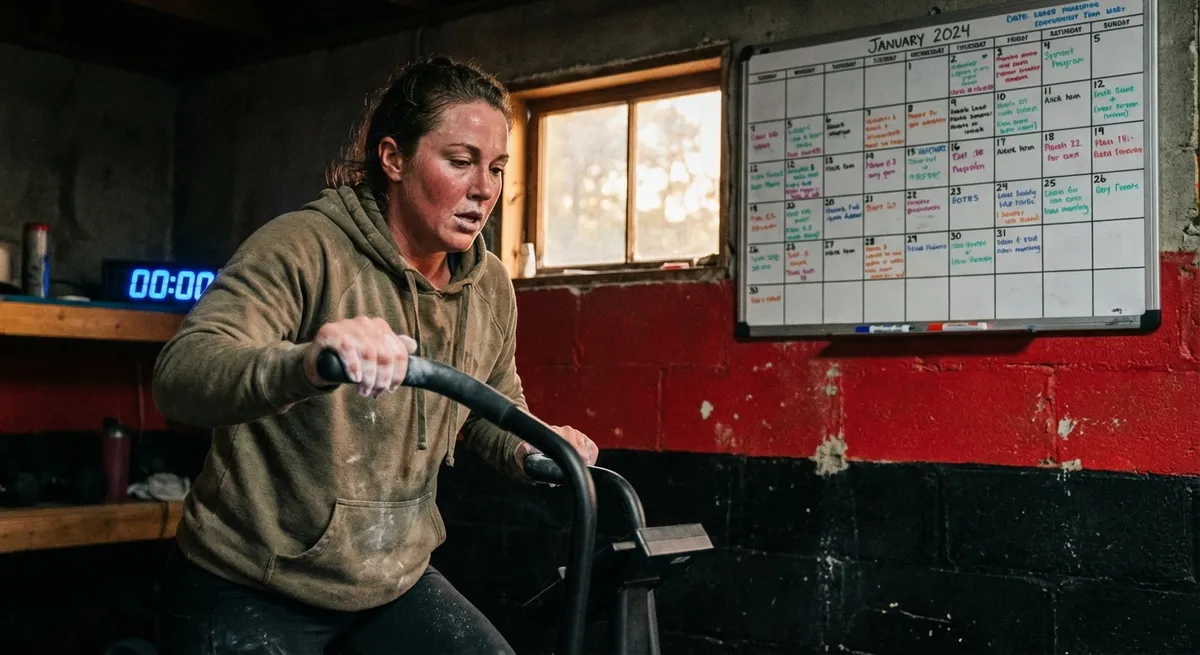
Why Tracking Your Workouts Changes Everything
Most people rely on vibes: “I think I’m getting stronger,” “I sort of remember what I lifted last week.” That’s not progress — that’s guessing. Tracking turns your effort into data, and data into momentum. When you see your numbers climb, your distance stretch, or your consistency streak grow, you stop wondering if you’re improving and start knowing you are.
Tracking also removes the emotional fog. Bad day? Cool — the log still shows you’ve been putting in work all month. Busy schedule? Your history proves you can carve out 20 minutes and make it count. Every entry is a mini contract with yourself: “I said I’d show up, and I did.”
Workout tracking doesn’t have to be complicated or time-consuming. It just has to be consistent. Pen and paper, app, notes on your phone — the best system is the one you’ll actually use. Once it’s part of your routine, it becomes your personal highlight reel: no filters, just facts.
Tip 1: Track Inputs, Not Just Outcomes
Most people only track scale weight or PRs, then get frustrated when the payoff is slow. Flip that. Track the inputs you can control: sets, reps, weights, distance, time, effort level, even sleep or hydration if it affects your training.
When you focus on inputs, you give yourself more ways to win. You might not hit a new squat PR this week, but you did sleep 7 hours, drink more water, and hit all three strength sessions. That’s progress — and tracking makes it visible.
Examples of inputs to log:
- Exercises and variations (e.g., incline push-ups vs. standard push-ups)
- Sets, reps, and load (weight used, resistance band color, etc.)
- Workout duration and rest times
- Perceived effort (a 1–10 scale works great)
- Notes on energy, soreness, or recovery
Over time, you’ll start to see patterns: what helps you crush a workout and what drags you down. That’s how you train smarter, not just harder.
Tip 2: Give Every Workout a Clear Mission
Random workouts lead to random results — and random motivation. Before you start, decide what today’s mission is and log it before you move: strength, endurance, mobility, speed, or recovery.
For example:
- “Today’s focus: lower-body strength and balance”
- “Mission: easy cardio + mobility — just keep the habit alive”
- “Goal: improve push-up form, not just crank out more reps”
Writing a one-line mission in your tracker sets your brain on a target. It also makes your log more meaningful than just numbers on a page. When you review your week and see each workout had a purpose, you’ll feel like an athlete on a program, not a random person in a gym.
When your motivation dips, scroll or flip through your past missions. You’ll see a story forming: not of perfection, but of intention. That builds pride — and pride is fuel.
Tip 3: Use Visual Wins You Can See at a Glance
Your brain loves visuals. Give it something to chase. Instead of burying your progress in long text notes, add visual cues that instantly show your effort.
Ideas you can use:
- Color code your days (green = workout done, yellow = light/recovery, red = missed)
- Create simple progress bars for weekly goals (e.g., 3/3 strength days, 2/2 walks)
- Use arrows next to exercises (↑ for progress, → for maintaining, ↓ for intentional deload)
- Screenshot or export weekly summaries and keep a “progress album” on your phone
The point is simple: make your progress impossible to ignore. When you open your tracking app or notebook and see row after row of completed boxes, arrows pointing up, and weeks filled with color, you won’t want to break the pattern.
Visual wins also make it easier to share your journey on social media. A quick snapshot of your week, a blurred screenshot, or a progress bar update turns your private wins into public inspiration — for you and for everyone watching.
Tip 4: Set “Minimum Viable Workout” Rules in Your Tracker
Life happens. Schedules explode. Motivation dips. Without a plan, those days become, “I’ll start over Monday.” Your tracker can stop that spiral with one powerful concept: the Minimum Viable Workout (MVW).
Your MVW is the smallest, no-excuses version of a workout that still counts. For example:
- 10 minutes of walking
- 2 sets of 3 exercises (bodyweight only)
- 5 minutes of mobility before bed
Write your MVW at the top or front of your tracking system and treat it like a contract. On rough days, open your tracker, see the MVW, and log that instead of quitting entirely. You still get to check off the day. You still keep your streak. You still show up for yourself.
Tracking your MVWs does two powerful things:
- It keeps your identity as “someone who works out” intact, even on bad days.
- It proves that consistency beats intensity in the long run.
Your future self will be way more impressed by a year of MVWs + solid workouts than by a month of all-out effort followed by burnout.
Tip 5: Turn Your Tracker Into a Reflection Tool, Not Just a Log
Your tracker shouldn’t just say what you did; it should help you understand why it’s working (or not). End each workout with a 30-second reflection note. Nothing fancy — just one or two lines.
Try prompts like:
- “What felt strong today?”
- “What held me back?”
- “What’s one thing I’ll adjust next time?”
- “One win I’m proud of from this workout is…”
- They reinforce the habit mentally, not just physically.
- They train you to notice progress you might overlook (better form, more control, less rest needed).
- They turn your log into a learning tool instead of a graveyard of numbers.
These tiny reflections do a lot:
When you look back over weeks or months, these notes will read like a personal coach in your own words. You won’t just see weight going up or times going down; you’ll see confidence building, resilience growing, and your mindset leveling up.
Conclusion
Tracking your workouts isn’t about being perfect; it’s about being honest. Honest about what you did, how you felt, and how you’re moving forward. When you track consistently, your fitness journey stops being a blur and starts becoming a clear story — one where you’re the main character and the author.
Choose your tracking method. Define your minimums. Give each session a mission. Capture visual wins. Reflect in a sentence or two. That’s how you turn “I hope I’m improving” into “I can prove I’m improving.”
Now open your tracker — or download one — and log your next workout like you mean it. Your future self is going to be obsessed with these receipts.
Sources
- American College of Sports Medicine – Importance of Goal Setting and Tracking - Explains how structured goals and monitoring support exercise adherence and performance
- Centers for Disease Control and Prevention – Physical Activity Basics - Outlines recommended activity levels and highlights the role of self-monitoring in staying active
- Harvard T.H. Chan School of Public Health – Physical Activity and Health - Reviews research on exercise benefits and how consistent activity tracking can enhance long-term health outcomes
- National Institutes of Health – Using Technology to Promote Physical Activity - Discusses how apps and digital trackers support accountability and exercise adherence
- Mayo Clinic – Fitness Program: 5 Steps to Get Started - Covers foundational steps for building a fitness routine, including tracking and monitoring progress