Why Accountability Hits Different When You Can See It
Accountability isn’t about shame; it’s about ownership.
When you track what you do — your workouts, your steps, your sleep, your food — you turn vague wishes into visible progress. Suddenly, it’s not “I think I’m doing okay,” it’s “I trained four times this week, hit my step goal, and improved my squat.” That clarity does three powerful things:
- Kills the “I’ll start over Monday” mindset. You’re not resetting; you’re building a streak.
- Exposes your patterns. You see exactly where you skip, stall, or shine.
- Builds self-trust. Every data point is another vote for “I show up for myself.”
Accountability is not about being perfect. It’s about being honest — consistently. The more honest your tracking, the more powerful your progress. When you treat your log like a scoreboard, your effort automatically levels up. You stop asking, “Am I motivated?” and start asking, “What’s my plan today?”
Tip 1: Track Fewer Things, More Consistently
If you try to track everything, you’ll track nothing for long.
Start small and relentless. Pick 2–3 core metrics that actually move the needle for your current goal, and commit to tracking them daily for the next 30 days. For most people, that looks like:
- Goal: Fat loss
Track: Daily steps, workouts completed, and average weekly protein intake.
- Goal: Strength
Track: Key lifts (weight/reps), total weekly sets, and sleep duration.
- Goal: General health
Track: Steps, active minutes, and sleep.
The win isn’t how fancy your tracker looks — it’s how consistent it is. A basic note on your phone, a spreadsheet, or a simple app beats a perfect system you abandon after a week. Your rule: simple enough you can do it on your most chaotic day.
Tip 2: Make Your Numbers Visible, Not Secret
Accountability multiplies when your data isn’t hiding.
Put your fitness receipts where you can’t ignore them:
- Set your step count or rings on your watch face or phone home screen.
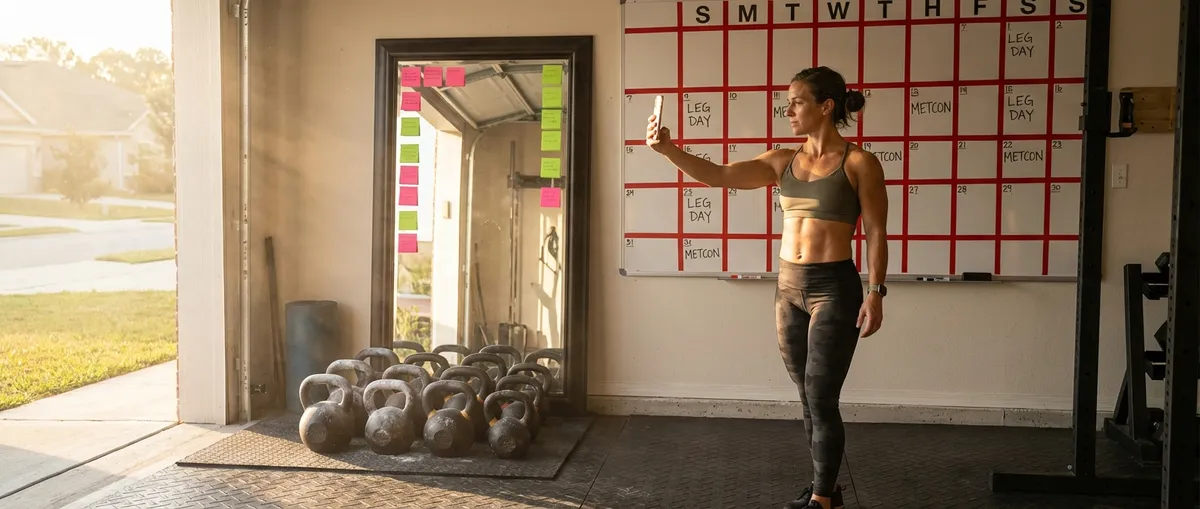
- Keep a printed workout calendar on your wall and cross off completed days.
- Use color-coding: green for “done,” yellow for “partial,” red for “missed.”
- If you’re comfortable, share weekly summaries with a friend, coach, or group.
Visibility creates pressure — the good kind. When your week is staring you in the face, you’re a lot less likely to skip “just this once.” That empty square, that red day, that incomplete streak? That’s your future self asking, “Are we really okay with this?”
Turn your tracking into a scoreboard you can actually see. When you do, your brain starts chasing wins, not just workouts.
Tip 3: Attach Every Log to a Tiny, Clear Standard
Don’t just track what you did — define what counts.
“Workout” is vague. “Workout = at least 30 minutes where my heart rate is elevated or I’m lifting with focus” is measurable. Clear standards turn your tracking from “I kind of did something” into “I hit my line or I didn’t.”
Set tiny but specific minimums for your key metrics:
- “A workout counts if I complete my planned sets, even if I lower the weight.”
- “Steps count as a hit at 7,000+, stretch goal at 10,000.”
- “Sleep goal is in bed with screens off by 11 p.m., 5 nights per week.”
- “Protein target is 20+ grams in at least 2 meals per day to start.”
This does two things:
- Removes wiggle room. You either met your standard or you didn’t.
- Makes ‘small wins’ legitimate. You don’t need a perfect day to log a real success.
Accountability loves clarity. When your brain tries to bargain (“It kind of counted”), your standard steps in and says, “Nope. Here’s the line. Did we cross it or not?”
Tip 4: Use Weekly Reviews to Call Out Your Own Excuses
Daily tracking is evidence. Weekly review is judgment day — in the best way.
Once a week, spend 10–15 minutes checking your data and asking honest questions:
- How many workouts did I plan vs. actually complete?
- What derailed me on the days I missed? (Sleep, schedule, mood, planning?)
- Where did I overperform? What helped that happen?
- What’s one friction point I can remove for next week?
Write it down. Don’t just think it; document it.
Your goal isn’t to beat yourself up; it’s to debug your life:
- If you always miss Monday workouts, maybe Monday becomes a “walk only” day and you hit harder on Tuesday/Thursday.
- If late-night scrolling crushes your sleep, set a phone reminder and charge it outside the bedroom.
- If you forget to log food, pre-log one meal the night before.
Accountability isn’t “I failed again.” It’s “I learned, I adjusted, I go again — smarter.” When you review your week with curiosity instead of criticism, you become your own coach, not your own bully.
Tip 5: Turn Tracking Into a Game, Not a Chore
If it feels like punishment, you will quit. If it feels like a game, you’ll keep playing.
Gamify your accountability:
- Streaks: How many days in a row can you hit your step goal or log your workouts?
- Levels: “Level 1 cardio” might be 2 walks per week; “Level 2” is 3; “Level 3” adds intervals.
- Challenges: “No zero days” — every day gets something, even if it’s just a 5-minute walk or 10 push-ups.
- Rewards: Non-food, non-fitness rewards when you hit consistent tracking for 2–4 weeks (new workout gear, a massage, a day trip).
Most people quit because their only feedback is the scale — and the scale is slow, stubborn, and sometimes misleading. Tracking lets you win daily, even when the mirror hasn’t caught up yet.
Celebrate “boring” wins: logged all week, slept 7 hours three nights in a row, added 5 pounds to a lift, hit 7,000 steps on a day you almost skipped. Boring consistency is where dramatic transformations are born.
Conclusion
Accountability isn’t about being watched; it’s about watching yourself with honesty and intent. When you track what you do, define your standards, review your patterns, and gamify the process, you stop drifting and start driving.
Your body will change. Your mindset will change. Your identity will change — from “I’m trying to be consistent” to “I am consistent.”
Start today. Pick your 2–3 metrics. Make them visible. Give them clear minimums. Review them weekly. You don’t need perfect effort — you need proof that you keep showing up.
Bring the receipts. Your future self is ready to cash them in.
Sources
- Centers for Disease Control and Prevention – Physical Activity Basics – Guidelines on activity levels and why regular movement matters for health
- American College of Sports Medicine – ACSM Guidelines for Exercise Testing and Prescription – Evidence-based standards for exercise programming and tracking meaningful metrics
- Harvard T.H. Chan School of Public Health – Sleep and Health – Explains how sleep impacts performance, recovery, and consistency
- National Institutes of Health – Self-Monitoring in Weight Management – Research on how tracking behaviors (like food and activity) improves adherence and outcomes
- Mayo Clinic – Fitness Trackers: How to Choose – Overview of fitness trackers and how they can support activity monitoring and accountability